
Get your ticket!
Mapping the Borders of Larp Research.
WHAT: Nordic Larp Research Seminar
WHEN: 15.4.2026, 11.30 – 18.00
WHERE: Gothenburg, Lindholmen Campus, Jupiter Building
A warm welcome to all larp and game studies academics, & students for a day of discussion on how to research larp. You can sign up and buy tickets by clicking the button. Tickets are 23 euro and include coffee/tea, lunch, fika and light dinner.
The academic seminar is organized by the Nordic Larp Research Network as a part of AWIG Knutpunkt 2026, organized in collaboration with the Game studies unit at Chalmers University of Technology/University of Gothenburg. It is part of a continuous effort from the Nordic Larp Research Network, to make more and better larp research, connect researchers and provide support for each other, and to find new projects to participate in. This year’s seminar asks: How are larps and larping researched? We seek to explore the methods, the researcher positions, and the research questions, as well as the paths for larp research not yet mapped.
PRE-PROGRAM for the research network seminar
09.00 – 17.00 Edu-larp seminar (whole day, in same building)
10.00 – 11.30 Panel-discussion: Accessibility in Analog Games. Free of charge. (Reserve a seat: Ticket page)
Initiated by Dr Michal Heron, Program manager at Game Development studies at Gothenburg/ Chalmers University, and author of a book about the subject. Michal Heron books on Routledge
In the academic panel: PhD Ville Kankainen (boardgames and hybridity), Doctoral Researcher and lecturer Markus Kämäräinen (game accessibility studies, digital games) Doctoral Researcher Hanne Grasmo (neurodiverse players, queer and crip theory analysis of inclusive analogue games).
In the larp expertise panel: Karjin van der Hej (larper and promoter about inclusive larp), Karin Edman (larp designer, writer, and organizer with accessibility focus) and Björn Buzen (Nordic larp talk about being a larper with disabilites)
11.30 LUNCH (for all)
Mapping the Border of Larp Research Methods, 12.00-18.00
Nordic Larp Research Network seminar (pre-sale tickets only) Tickets-larpresearch-seminar-2026
12.00 Opening of seminar
Joffe Rydberg and Hanne Grasmo
12.15 Keynotes:
o PhD Erika Lundell; Larp ethnography.
o Doctoral researcher Johanna (Joc) Koljonen: How do we – academically – know?
13.15 MINGLE
13.30 A. Presentations and feedback: Methods in borderlands
- Ludic Inquiry: A New Methodology for Larp Research. Leland Masek (Tampere University)
- Bahay-bahayan as Research Methodology: Filipino Immersive Play Praxis for Larp Research and Instructional Design. Ana K P de Jesus & Gian Carlo de Jesus (University of the Philippines Los Baños)
- ABSTRACT: Breaking the Bureaucratic Script: LARP as a Method for Unlearning in the Public Service. Shawn Chua (Civil Service College, Singapore)
- ABSTRACT presentation: Confessional Tales from the Larp Realms: Insider knowledge in participatory observations studies. Hanne Grasmo (Tampere University/Larpocracy)
14.40 BREAK
15.00 B. Presentations and feedback. Learning by larping
- Learning to Larp: Methodological Insights from Socio-Educational Applied Ethnography Luca Fele (University of Bologna)
- Role-playing Games and Conflict Transformation in Higher Education. Alexandra Schreiber, Kjell Hugaas, Sarah L Bowman (Uppsala University)
- Scripts of the Past: How Just a Little lovin’ shapes Queer Historical consciousness. James Lancaster (Örebro University)
16.00 Short info session:
Nordic Larp Research Network, current research
16.20 Tiny break
16.30 C. Presentation and feedback. Evaluating Change by Design
- Larp Design as Catalyst for Behavioural Change. Tiziano Antognozzi and Alessandro Giovannucci (Belle Arti di Venezia)
- Democracy in Live Action: A Mixed Method Analysis of Political Larps and Participants who Play Them. Sarah Lynne Bowman, Marcin Słowikowski , Weronika Szatkowska, Piotrek Warzyszynski , Barbara Mos (Uppsala University/Larpocracy)
17.10 D&D (dinner&discussion):
What are larp research methodologies and methods today – and how to develop in the future? We are serving light dinner while we discuss in groups around tables.
17.45 Ending comments: Joffe and Hanne
Read the papers beforehand:
An important part of the seminar is giving and getting feedback. From 5. of April you can familiarize yourself with the submitted article drafts from this folder: https://drive.google.com/drive/folders/1M8xfXUM0nO2u_T3OIC7wiAE7jieWVVox?usp=sharing
Here we will keep an updated program, as well as a participant lists (after the seminar).
Post-program
18.30 Doors open for Nordic Larp Talks
19.00 Nordic larp Talks
A warm welcome to the Nordic Larp Research Networks annual seminar! – as a contributor, an academic or just curious about larp research and academic methods, in Jupiter Building at Lindholmen Campus, Gothenburg/Chalmers Universities at 15.4.26 from 11.30-18.00
More information about the network and the seminar can be found on our web site larpresearch.com (beta version). Remember that you need tickets for the seminar(s)!
We are collaborating with Gothenburg/Chalmers University to make all this program happen and they invite us to lunch at 11.30. They have also initiated a panel discussion about Accessibility and inclusion in analogue games – please join that too (10.00-11.30)!
We have wonderful contributors coming from near and far to present their research, as well as keynote holders and academic experts. Join us to get food – for thoughts, body and soul.
Best regards from Joffe Rydberg and Hanne Grasmo (organisers)
Mapping the Borders of Larp Research
-The Academic seminar of the Nordic Larp Research Network
Through larps we can explore play, performance, culture, sexuality (Grasmo and Stenros 2022; Harviainen 2011), politics, queerness (Sihvonen & Stenros 2019) and humanity in general. Researchers also seek to understand game design, the concepts and the culture of larping (Bowman et al. 2024), the history of larping (Joelsson 2025), and how to employ larp for education (Bowman et al. 2024). While others employ larp as a method to study a range of themes, from communicating science (Steyaert et al. 2023) to a climate friendly future (Op de Beke 2020), from neurodivergence (Visuri 2024) to social media (Bjärstorp and Ragnerstam 2023) and governance (Andersen 2021). Research-through-art and design also explore larp in various ways (Harper 2022; Lassila 2024; Ringlund & Smebold 2024; Rydberg 2022-2025).
This year’s seminar of the Nordic Larp Research network asks: How are larps and larping researched? We seek to explore the methods, the researcher positions, and the research questions, as well as the paths for larp research not yet mapped. Our starting point is research about and in the Nordic larp movement and adjacent communities. Larp research employs a multitude of methods, from analysis of Facebook posts (Stenros & Sihvonen 2019) to participatory observation (Lundell 2014; Bowman 2010), from qualitative interviews (Englund 2014) and literature reviews (Bowman 2014) to larp design as research method (Johanson et al. 2024; Baird and Bowman 2022) and archive studies (Joelsson 2025)
You are invited to send in an abstract for a work-in-progress paper that fits the theme “Mapping the Borders of Larp Research.” If your abstract is selected, we will ask for a full draft article sent in before the seminar.
Some possible ideas for themes might be:
Larp as a method to explore other research questions.
How to ensure high quality in larp research?
Larp research interacting with and affecting larp experience and design.
Taboos in larp research; what supposedly cannot be researched?
What methods do we have to understand larp?
Is there a future for quantitative larp research?
Larp design as research.
Observational studies by larpers: Confirming biases?
Video in larp research.
Who to interview about larp – and when to do it.
How different fields conduct larp research – how can we do interdisciplinary work?
Decolonizing larp research
Action research
Larp as performance as research: Artistic larp research
Seminar information
The seminar will take place in Gothenburg, Wednesday 15th April 2026, (ca 12.00-18.00), in the week before the international larp conference Knutpunkt. The seminar focuses on working papers, and the aim is to provide gaming scholars with tools and peer-to-peer discussion for developing and refining their papers further. Every paper will be presented for 10 minutes and discussed for 10-20 minutes. The presentations should be drafted with an academic audience in mind.
Everyone attending the seminar with a paper will be asked to comment on two other papers. The aim is that all participants will familiarize themselves with the papers in advance. The seminar presentations should encourage discussion instead of repeating the information presented in the papers.
The Nordic Larp Research seminar collaborates with The Game Development and Technology program at University of Gothenburg/Chalmers University of Technology, hence the venue will be at Lindholmen Science Park. In the morning of 15th April Dr Michael Heron (Head of the game design program) will co-host with us a panel about accessibility in analogue games, that you are welcome to join.
The seminar will potentially parent with a publisher for a special issue on larp research, such as The International Journal of Role-playing. After the conference, selected papers would be invited to be further developed for publication, through an additional open peer-review process. Note that acceptance into the seminar does not guarantee publication in a special issue should we choose to pursue one.
Deadlines:
- February 1st, 2026: extended submission deadline
- March 15, 2026: Seminar drafts due for distribution to participants.
- April 15, 2026: Seminar takes place in Gothenburg.
- June 1: Decision on the feasibility of pursuing a special issue.
The seminar will partly be parallel to the Edu-Larp Conference (link here), but it is possible to attend that conference in the morning hours. In the evening, you can join The Nordic Larp Talks (LINK), and on Thursday the Art-and-Larp seminar Sublime Pretense (LINK).
Submission guidelines
You are invited to send in an abstract to a paper for this seminar, to be peer-reviewed. If your abstract is accepted, we will ask you for a draft for a work-in-progress paper; this will be read by other participants at the seminar, and presented at the seminar by you and/or your co-author(s).
The papers will be selected for presentation based on extended abstracts of 400–800 words (before references). Abstracts should include at least five (5) academic sources from role-playing game studies. Abstracts should be delivered in PDF format.
The draft to be submitted before the deadline will have a maximum length of 5000 words (before references). References should be in Chicago Author-Date form (17th edition). Full paper guidelines will be provided with the notification of acceptance.
Submissions should be sent through this form. You have to provide a link to your abstract.
All information will be updated on the seminar website: larpresearch.com
Organisers can be contacted at: Hanne Grasmo, hanne.grasmo@tuni.fi, +358504084296 and Josephine Rydberg, josephine.rydberg@uniarts.se, +46 70 5877955
The Organising Team:
Hanne Grasmo is a queer Norwegian larper, larp designer, writer, activist and sociologist. She is a Doctoral Researcher at Game Research Lab at Tampere University, researching Sexual Arousal and Larp (https://gameresearchlab.tuni.fi/researchers/). Currently employed by Larpocracy EU-project (https://www.larpocracy.eu/ ) to study Larp Festivals, and is affiliated with the Centre of Excellency in Game Culture Research (https://coe-gamecult.org/ ).
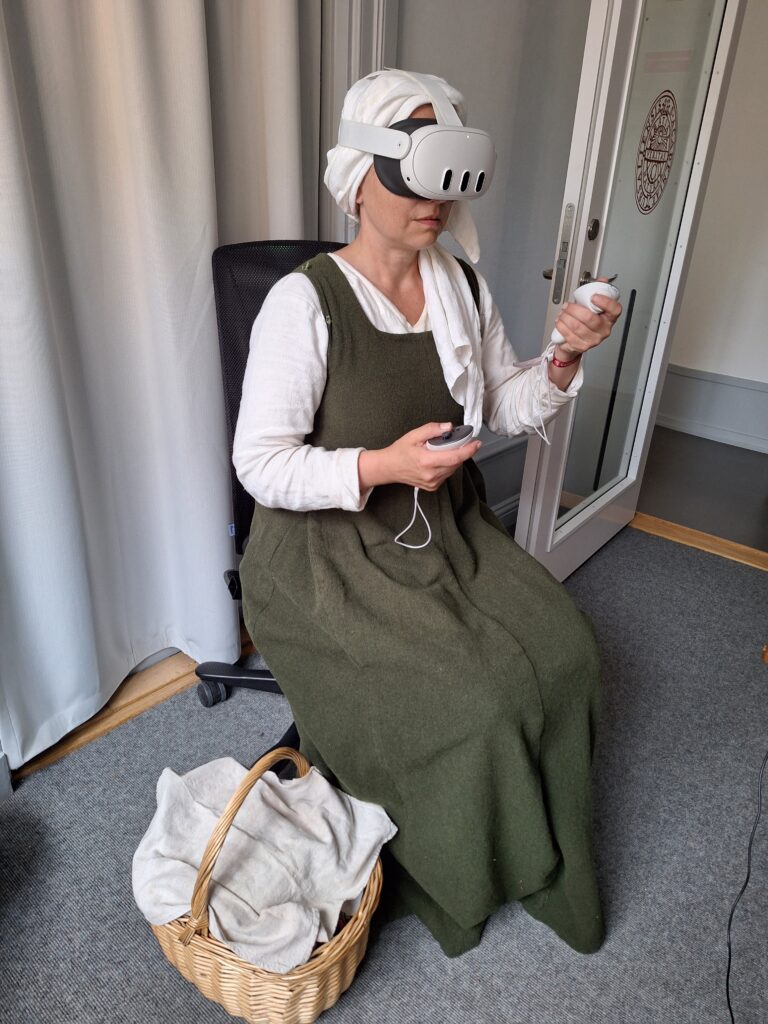
Josephine (Joffe) Rydberg: Swedish larper, designer and cultural worker. Phd candidate at Stockholm University of Arts. Looking at Dramaturgy for Participatory Practices through the lens of VRlarp (larping in virtual reality). https://www.researchcatalogue.net/view/1748748/1748749
Cultural developer at Region Gävleborg (county council), Dept. for Culture.
Jonne Arjoranta will overview the peer-reviewing process. Jonne is a Finnish larper and University Lecturer at Jyväskylä University. He holds a doctoral degree in digital culture and is specialized in philosophical hermeneutics, game studies and internet cultures. He has published, for example, in Game Studies, Games and Culture and International Journal of Role-playing, and is the editor-in-chief for the Finnish Yearbook of Game Studies.
J. Tuomas Harviainen (PhD, MBA) will join the editorial team in case of a Special Journal Issue. He is Professor of Information Studies and Interactive Media at Tampere University, Finland. Harviainen is a Finnish larper and has studied larps for over two decades, and is a NACS authorized Specialist in Scientific Sexology.
Jamie Harper (PhD in arts) will eventually join the editorial team as copy-editor/proof-reader. He has experience as an artist, larp designer and larper in the UK and in the Nordic traditions. His doctoral thesis discussed larp and performance. He is currently a university lecturer at Plymoth University, but has recently relocated to Tampere.
In addition we have a team of peer-reviewers.
References:
Andersen, Ming Unn. 2021. “Playing make believe in the Finnish Digital Agency. Exploring socio-political implications in the digital public sector through Speculative Design and Live Action Roleplay.” Master thesis at Aalto University School of Arts, Design and Architecture.
Bowman, Sarah L., and Baird, Josephine. 2022. “The transformative potential of immersive experiences within role-playing communities. Revista de Estudos Universitários-REU, 2022
Bowman Sara Lynne. 2014. “Educational live action role-playing games.” In The Wyrd Con Companion Book, 2014. Educational live action role-playing games: A secondary literature review
Brown, Ashley M.L., and Stenros, Jaakko. 2018. “Sexuality and the Erotic in Role-Play.” In Zagal, José P. & Deterding, Sebastian (Eds.): Role-playing Game Studies: Transmedia Foundations. New York; Routledge. [pdf]
Bjärstorp, Sara, and Ragnerstam, Petra. 2023. “Live-action role-playing and the affordances of social media”, Culture Unbound, 15(2). doi: 10.3384/cu.4184.
Bowman Sarah Lynne.2024. “Immersion and shared imagination in role-playing games”. Chapter in The Routledge Handbook of Role-playing Game Studies. Routledge
Bowman, Sarah Lynne. 2013. “Social Conflict in Role-playing Communities: An Exploratory Qualitative Study.” International Journal of Role-Playing 4: 17-18.
Bowman, Sarah L., Josefin Westborg, Doris C. Rusch, Josephine Baird, Kjell Hedgard Hugaas, and Kaya Toft Thejls. 2024.”Role-playing Games as a Tool for Training Interdisciplinary Collaboration”. In Bowman, Sarah L., and Westborg, Josefin (eds) CIRCUS Interdisciplinary Insights 2 Role-playing Games for Interdisciplinary Research Collaborations. Five role-playing game scenarios for interdisciplinary research collaborations
Englund, Tindra. 2014. “Live action role play (larp) in a context of conflict: An ethnographic study of larp in Ramallah”. Master thesis at Malmö University. FULLTEXT01.pdf
Grasmo, Hanne, and Stenros Jaakko. 2022. “Nordic Erotic Larp: Designing for Sexual Playfulness”. International Journal of Role-Play, No 12, 62-105.
Harper, Jamie. 2022. “Performing Resilience: Anchorage and Leverage in Live Action Role-Play Drama”. In: Journal of Contemporary Drama in English, 10:1. Pp. 83-98. https://researchportal.plymouth.ac.uk/files/42388686/Performing%20Resilience.pdf
Harviainen, J.Tuomas. 2011. Sadomasochist role-playing as live-action role-playing: A trait-descriptive analysis. In: International Journal of Role-Playing 2: pp 59–70. https://journals.uu.se/IJRP/article/view/194
Joelsson, Tapani. 2025. “Origins of Finnish Live-Action Roleplaying Events”. Paper presentation at Ropecon Academic seminar 2025, Helsinki.
Johanson, Karin, Raquel Robinson, Jon Back, Sarah Lynne Bowman, James Fey, Elena Márquez Segura, Annika Waern, and Katherine Isbister. 2024. “Why Larp? A Synthesis Article on Live Action Roleplay in Relation to HCI Research and Practice.” In ACM Trans. Comput.-Hum. Interact. 31, 5, Article 64 (October 2024), 35 pages. https://doi.org/10.1145/3689045
Lassila Katri. 2024. “The Cliff – A Case Study of Interdisciplinary Larp Methods for Artistic Research Practice”. In Nordiclarp.org (retrived 28.8.25). https://nordiclarp.org/2024/03/25/the-cliff-a-case-study-of-interdisciplinary-larp-methods-for-artistic-research-practice/
Lundell, Erika. 2014. Förkroppsligad fiktion och fiktionaliserade kroppar. Levande rollspel i Östersjöregionen. Södertörn Doctoral Dissertations, 1652-7399; 93 https://bibl-app.sh.se/publicationseries/home/publication/diva2_718428
Op de Beke Laura (2020-21) Playing with deep time. What if we looked at the deep future as a collaborative multi-species project? Project at Oslo University https://www.hf.uio.no/ikos/english/research/center/oseh/collaboratories/playing-with-deep-time.html
Ringlund OM and Smedbold H (2024) Focuses on the aesthetics of VR storytelling (about Nadja Lipsyc public defence of her artistic PhD). Published at University of Inland 16.05.2024. https://www.inn.no/english/research/doctoral-degree/public-defences/vr-storytelling/
Rydberg, Josephine. 2022-2025. Larp Practices in VR – research exposition ongoing (for an Artistic PhD). Stockholm University of the Arts & Region Gävleborg. https://www.researchcatalogue.net/profile/show-exposition?exposition=1748748
Steyaert PMA; Kiefer S; Marshall OCM; Bruun, J. 2023. “Road to Trappistenum – Exploring Exoplanets”. Oral presentation at Bloom Festival 2023: Festival om natur og videnskab. Department of Science Education Center for Digital Education.Denmark: Søndermarken. https://researchprofiles.ku.dk/en/activities/road-to-trappistenum-exploring-exoplanets
Stenros, Jaakko, and Sihvonen, Tanja. 2019. “Queer while Larping. Community, Identity, and Affective Labor in Nordic Live Action Role-Playing”. Analog Game Studies, Vol 6, No 4.
Stenros, Jaakko. 2014. “In Defence of a Magic Circle: The Social, Mental and Cultural Boundaries of Play.” Transactions of Digital Games Research Association, Vol.1 No 2, 147-185. DiGRA. [pdf]
Stenros, Jaakko and Montola, Markus (eds.). 2017. College of Wizardry: The Magic of Participation in Harry Potter Larps. Pohjoismaisen roolipelaamisen seura. Free digital edition.
Visuri, Ingela. 2024. “Autistic re-creation: Live action role-play as a safe and brave space for social learning”. In: Thinking Skills and Creativity, Volume 54, 2024, 101622, ISSN 1871-1871, https://doi.org/10.1016/j.tsc.2024.101622.
Waldron, Emma Leigh. 2014. “Larp-as-performance-as-research”. In Analogue Game Studies. https://analoggamestudies.org/2014/08/larp-as-performance-as-research/
Join the Nordic Larp Research Network!

The Nordic Larp Research Network had our first seminar in connection with Solmukohta conference in Tampere 2024 (15 attendees), and then adjacent to Knutepunkt conference in Oslo 2025 (around 40 attendees).
We are larp researchers in the Nordic countries, and beyond, focusing on Nordic style larps. In 2023 we applied for Nordic Grant for Network building (Nordic Culture Point), with 19 signatures, and described our network in this way:
“A network for researchers of Nordic larp with aims of: Deepening our understanding of Nordic larp as f.i. art, game culture, political activism, education and medium for transformative impacts, through research. Develop collaborative research projects, disseminate knowledge and reach other fields of research through meetings and seminars.
(And in this way..)Contribute to future design of Nordic larp, both analog, VR and online larp, with a special focus on research through art and design.” (We did not get the grant)
Nordic larp is the name of a specific tradition of (mostly) analog role-playing games (Stenros & Montola 2010). This tradition is teached by universities, also in US, and designers all over the world use “Nordic larp” as a label to describe their larp. The tradition is recognized by bespoke design, co-operative storytelling, focus on immersion into the character and “play-to-loose”, not to win.
There is also a tendency to have social-realistic themes and a story in dialogue with the out-of-game-reality. Nordic larp can be used for political activism (Larp Politics book 2016) and creating (queer) heterotopias (Hutchings and Giordino 2016). For players, larp as an improvisational process entails embodying and performing as fictional characters, creating meaningful experiences, and engaging in narratives through interaction with other players (Harviainen et al. 2018).
Players, organizers and designers of Nordic larp have developed this specific form through an annual larp conference, Knutepunkt/Solmukohta, started in 1997, rotating between four Nordic countries (Finland, Sweden, Norway, Denmark) with up to 600 participant from 40 countries.
There is a great network and collaboration between designers of both Nordic and Baltic countries, resulting in f.i.: Larp Writers Summerschool and several Nordic & Baltic larp festivals (e.g. Grenselandet in Norway, Black Box Copenhagen, Stockholm Scenario Festival, Vilnius Larp Fest and Immersion in Finland).
The research on Nordic larp started through the Knutepunkt/Solmukohta larp conventions, with books being published with (para-academic) articles and essays about design. The last few years a growing body of academics, from master students to doctoral researchers and even professors have been researching and publishing articles on Nordic larp traditions. But each of these researchers are often working alone, is one of very few in their research group and at academic conferences, whether this is in artistic research, social sciences, culture and media studies or game studies. There is a great need for an academic network to support and develop Nordic larp research. We are trying to build that.
/

